What Is Amazon SQS?
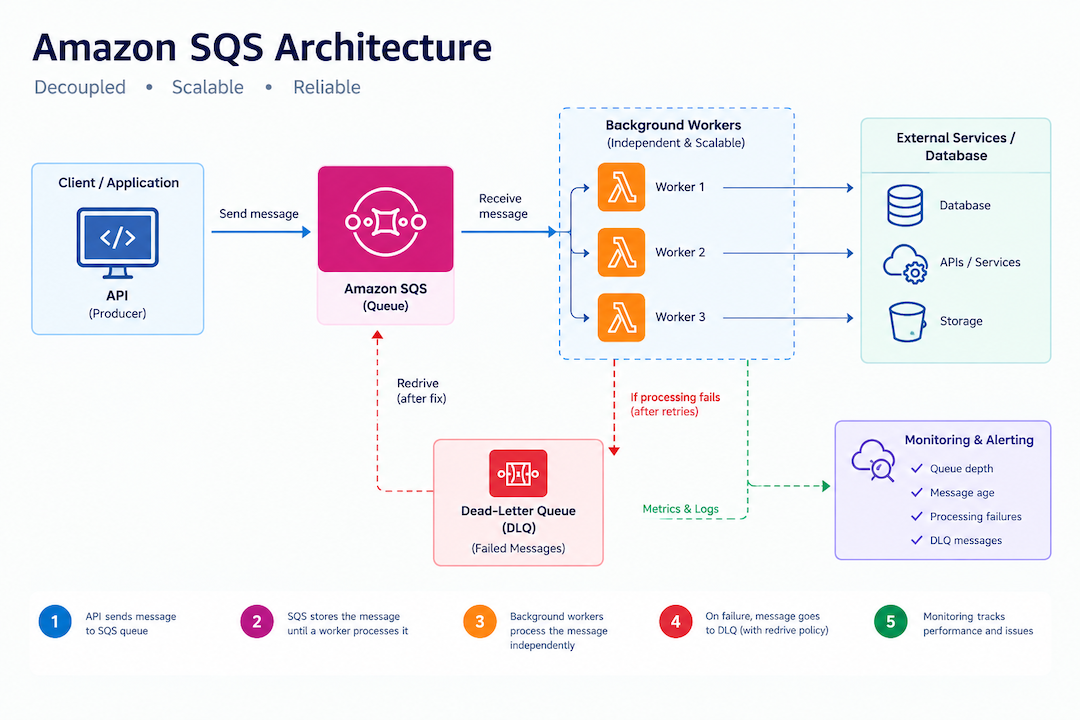
Amazon SQS allows one application to send messages to a queue while another processes them independently. This reduces direct dependencies between services and improves scalability and fault tolerance.
Example: An e-commerce application can accept an order immediately and process payment notifications, emails, and invoice generation in the background.
How Amazon SQS Works
Architecture: Producer → SQS Queue → Consumer → Database / External Service
Producer: Sends a message to the queue.
SQS Queue: Stores the message until a consumer processes it.
Consumer: Retrieves and processes the message.
Delete message: After successful processing, the consumer deletes it from the queue.
Messages become available again if processing fails and the visibility timeout expires.
Types of SQS Queues
Standard Queue: High throughput, at-least-once delivery, and best-effort message ordering.
FIFO Queue: Preserves message order within a message group and supports deduplication to reduce duplicate sends.
Use Standard for scalable background jobs and FIFO when processing order is important.
Key Features
Decoupling: Services operate independently.
Scalability: Handles changing workloads.
Long polling: Reduces empty receives and unnecessary API calls.
Visibility timeout: Prevents a message from being received by other consumers while it is being processed.
Dead-letter queue (DLQ): Isolates messages that repeatedly fail.
AWS Lambda integration: Runs event-driven processing without managing servers.
Production Best Practices
Make message processing idempotent to handle duplicate deliveries safely.
Set visibility timeout according to processing duration.
Configure a DLQ and an appropriate redrive policy.
Use long polling to reduce empty receives.
Monitor queue depth, message age, processing failures, and DLQ messages.
Apply least-privilege IAM permissions and encryption.
Avoid putting sensitive data directly into messages unless required and properly protected.
Important: SQS does not automatically guarantee exactly-once business processing. Consumers must handle retries and duplicate deliveries safely.
Common Use Cases
E-commerce order processing
Email and notification delivery
Payment event workflows
Image and document processing
Microservices communication
AI tasks and background jobs
For payment workflows, use idempotency and a reliable event-publishing pattern, such as a transactional outbox, to reduce duplicate processing and lost events.
Amazon SQS vs. Redis Queue
SQS is a managed AWS messaging service designed for durable, decoupled processing. Redis-based queues can be useful when an application needs low-latency job processing and already operates Redis. The right choice depends on durability, ordering, infrastructure, throughput, and operational requirements.
Conclusion
Amazon SQS helps developers build scalable, fault-tolerant applications by separating message producers from consumers. With retries, dead-letter queues, monitoring, and idempotent consumers, teams can build more reliable background-processing systems.
Need a scalable backend or cloud integration? Leamsoft helps businesses build custom applications, APIs, cloud solutions, and automation systems tailored to their workflows.
Contact: info@leamsoft.com
Leamsoft — AI-Powered Digital Systems for Modern Business.